
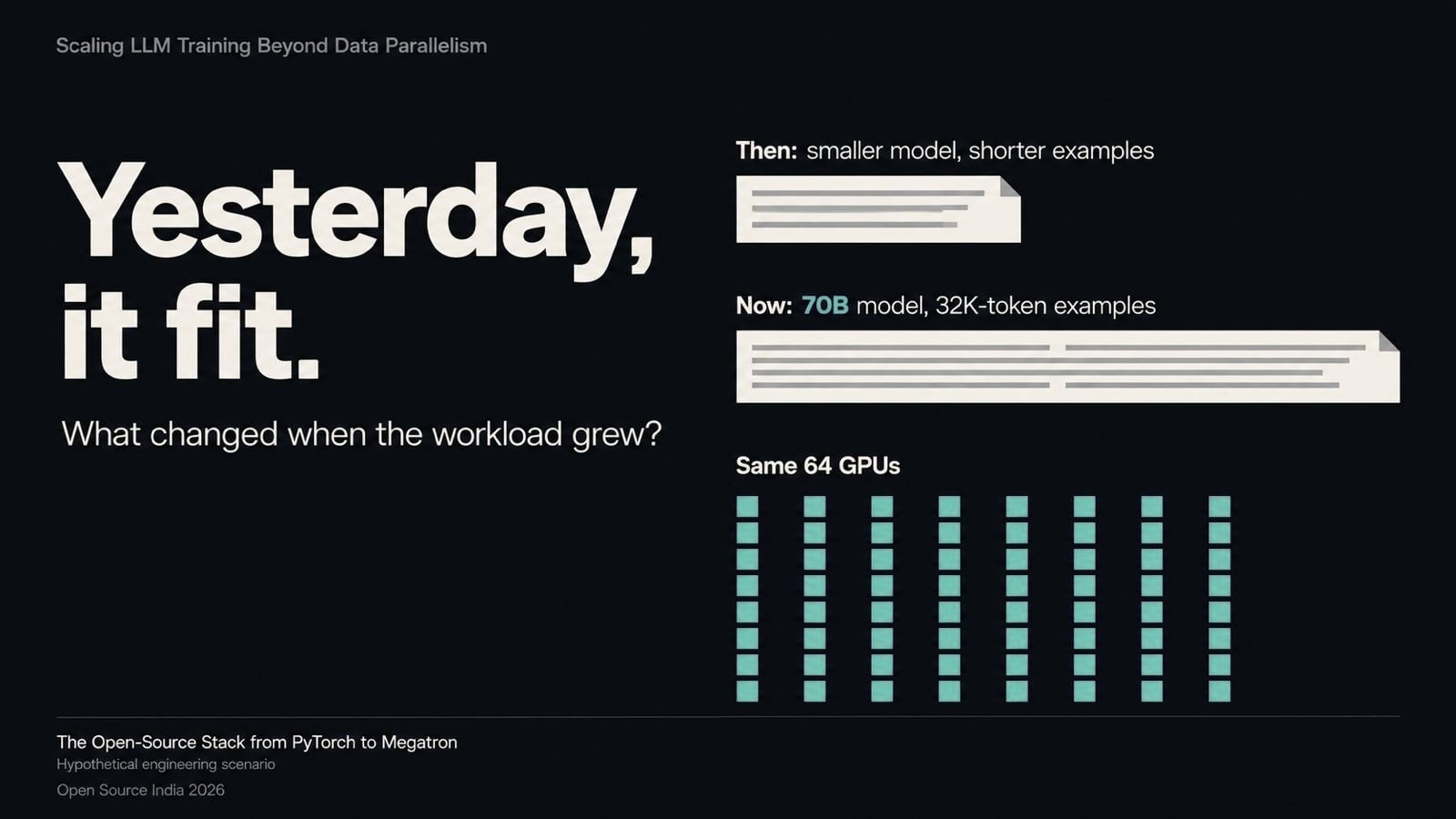
Yesterday, It Fit: Dividing a 70B Model Across 64 GPUs
A worked example in training memory, long context, and choosing a parallel layout you can actually evaluate.
A worked example in training memory, long context, and choosing a parallel layout you can actually evaluate.
The decision as a cost calculation, not an ideology and why the idle accelerator is the cost nobody puts on the slide.

Move fewer bytes per token, quantization (FP8/FP4), KV-cache compression, and speculative decoding and what each one costs.

Static vs. continuous batching, prefill-decode disaggregation, and the throughput-latency tradeoff you're really choosing.

Why the model that felt fast in the demo gets slow and expensive in production and the memory bottleneck nobody budgets for.

When data parallelism hits its ceiling: sharding model state, splitting layers and sequences, and why the interconnect picks your strategy

A from-scratch data-parallel wrapper that overlaps gradient sync with the backward pass and buckets the collectives — and how to verify it on a profiler trace.

How trading FLOPs for HBM works and the metric that makes a less efficient run look more efficient.

Why activations, not parameters, are what really push you out of HBM and what to do about it.
